
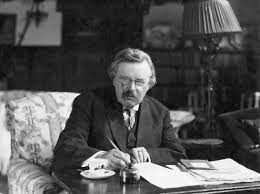
Essays: On the Delightful Art of Arguing with Paper
An Ode to Essays, Penned in the Spirit of G.K. Chesterton
The Mighty Essay: A Defense and a Celebration
If ever there was a literary form accused of loitering in the corridors of academia, it is the essay. It is a most misunderstood thing—like the umbrella, or the teapot, or the Englishman on holiday. The essay, we are told, is a schoolboy’s burden, a scholar’s drudgery, a task for examination halls. But I protest! It is, in truth, the splendid sport of the mind; a verbal fencing match where one may thrust and parry with ideas, and perhaps—most importantly—contradict oneself with complete freedom (Chesterton, Alarms and Discursions).
The Essayist: A Cheerful Contradiction
Consider G.K. Chesterton, that jovial knight of paradox. He wrote essays as a cook tosses salads: with gusto, with surprise, and with the conviction that even the cucumber’s dullness may be redeemed with enough vinegar. (Chesterton, Tremendous Trifles). Chesterton never saw a dull subject—only dull minds encountering subjects. He wrote on cheese, on lying in bed, on running after one’s hat (Chesterton, Alarms and Discursions; Chesterton, Tremendous Trifles; Chesterton, All Things Considered). And in so doing, he revealed that the essay’s proper business is not instruction, but delight.
The Essay as Exploration, Not Edict
There is an idea amongst the humorless that an essay must state a thesis, and then defend it as one would a fortress, with boiling oil and stern frowns. Chesterton, however, teaches us that essays are better as rambles through the countryside: one sets off for the hill, but may find a better view in the next valley. An essayist is an explorer, not a customs officer (Montaigne).
On the Joy of Wandering
How often do we permit ourselves, in this brisk and businesslike age, to follow a thought simply for the fun of it? The essay is a celebration of such wandering. It is the first cousin of conversation, the distant relative of debate, and perhaps, the sworn enemy of PowerPoint presentations. Chesterton’s essays are full of joyous zigzags and unexpected turns, the written equivalent of a child’s delighted dash through puddles (Hazlitt; Lamb).
Seriousness, Lightly Worn
It was Chesterton’s particular genius to treat light subjects seriously, and serious subjects lightly. The essay, in his hands, became a game—but a game in which the stakes are nothing less than truth and beauty. To write an essay is not to deliver a sermon, but to offer an invitation: “Come, let us consider this thing together, and see how odd—and wonderful—it is” (Chesterton, All Things Considered).
The Living Essay: A Conversation Across Time
When we read or write essays in the Chestertonian spirit, we join a conversation that stretches across centuries. Montaigne, Hazlitt, Lamb, and Chesterton himself sit at the table, gesturing with their pens, smiling at one another’s wit, disagreeing cheerfully (Montaigne; Hazlitt; Lamb; Chesterton, Alarms and Discursions). The essay is not a pronouncement; it is an exploration, a celebration, and—above all—an invitation to think, to laugh, and to wonder.
Conclusion: The Essayist’s Mission
So let us reclaim the essay from the red pen of the examiner and the groan of the student. Let us, in the style of Chesterton, fill our essays with paradox and play, seriousness and silliness, wandering and wondering. For to write an essay—to truly write one—is to argue with the world, and with oneself, to the delightful music of the turning page (Chesterton, Tremendous Trifles).
Works Cited
Chesterton, G. K.
Alarms and Discursions. London: Methuen & Co., 1910. Internet Archive. Accessed 31 Oct. 2025.
Alarms and Discursions. Wikisource, https://en.wikisource.org/wiki/Alarms_and_Discursions. Accessed 31 Oct. 2025. [archive.org], [en.wikisource.org]
Tremendous Trifles. London: Methuen & Co., 1909. Project Gutenberg. Accessed 31 Oct. 2025.
Tremendous Trifles. Wikisource, https://en.wikisource.org/wiki/Tremendous_Trifles. Accessed 31 Oct. 2025. [gutenberg.org], [en.wikisource.org]
All Things Considered. London: Methuen & Co., 1908. Project Gutenberg. Accessed 31 Oct. 2025.
All Things Considered. Wikisource, https://en.wikisource.org/wiki/All_Things_Considered. Accessed 31 Oct. 2025. [gutenberg.org], [en.wikisource.org]
Hazlitt, William.
Essays of William Hazlitt. London; New York: Walter Scott, 18AD. Internet Archive. Accessed 31 Oct. 2025.
The Round Table: A Collection of Essays on Literature, Men, and Manners. Project Gutenberg. Accessed 31 Oct. 2025.citeturn6search66
Lamb, Charles.
The Essays of Elia. Boston, New York, etc.: Houghton, Mifflin and Company, 1907. Library of Congress. Accessed 31 Oct. 2025.
The Essays of Elia. HathiTrust Digital Library, http://catalog.hathitrust.org/Record/100547342. Accessed 31 Oct. 2025. [loc.gov], [dp.la]
Montaigne, Michel de.
The Essays of Michel De Montaigne. New York: A.A. Knopf, 1934. Project Gutenberg. Accessed 31 Oct. 2025.
Essays of Michel de Montaigne. Wikisource, https://en.wikisource.org/wiki/Essays_(Montaigne)). Accessed 31 Oct. 2025. [owl.purdue.edu]