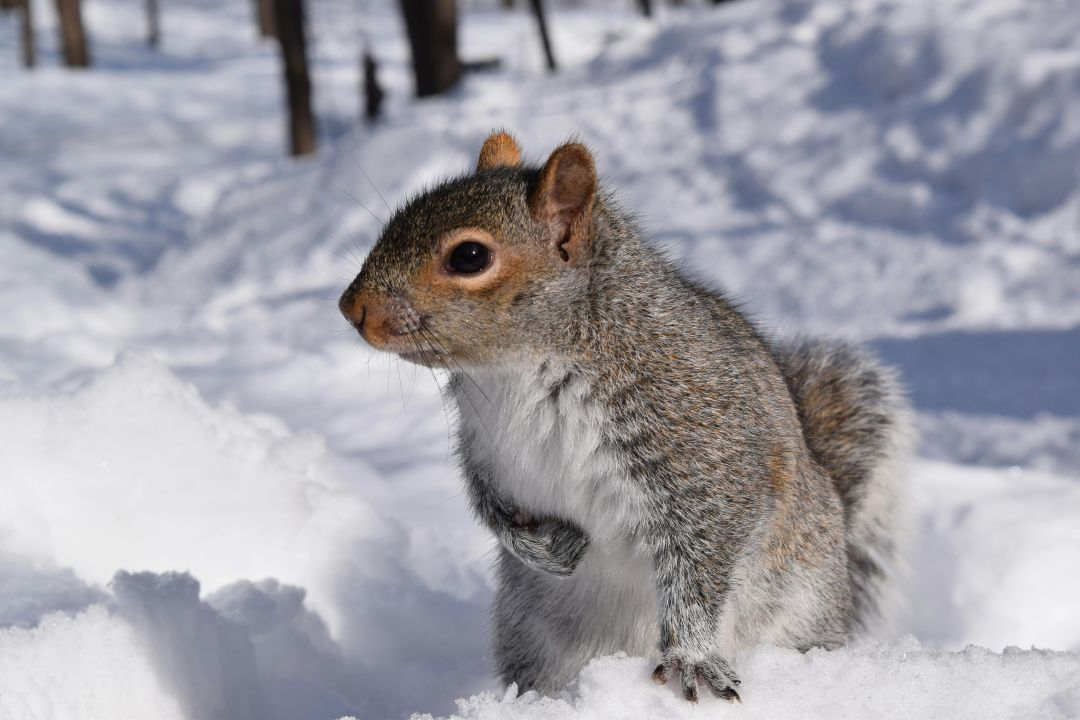
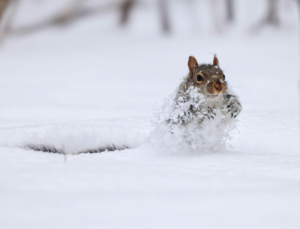
It is late January in Mt. Pleasant, a small hamlet in Upstate NY., located inland about fifteen miles east of Lake Ontario. This early morning it is bitterly cold at 5°F, not so pleasant in Mt. Pleasant. It’s obvious it doesn’t bother the gray tree squirrels who are jumping from limb to limb at the tree line of my backyard. Ha! this time one of them missed and I watched him fall speedily to the ground, a trail of snow shaken from the limbs, following right behind him. He’s not deterred, off he goes back up a tree, quick to find his friends and continue their morning play. Their determination (or sheer stubbornness) always makes me laugh. What I marvel at the most about these rodents of the woods is their resilience and adaptability; nothing deters them from their main goal, food!
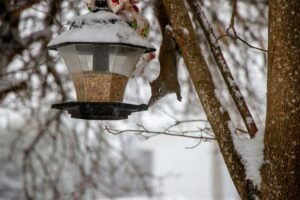
While I am delighted by these little creatures, my husband, however, is less amused. They double as our bird feeder bandits. Much to his chagrin, nothing he’s tried has deterred them. He has used a couple of methods to stop them from reaching our bird feeders and the precious sunflower seeds they contain. Our feeders are suspended on a metal wire attached between two trees. He first cut metal disks about fifteen inches in diameter with holes in the center, placing them on either end of the wire. The theory being that the spinning disks would stop them from getting a grip. They vaulted over the spinning disks with gymnast‑level finesse, barely breaking stride. Lastly, he purchased blocking spikes, while intended for poles, he simply retrofit them with cable clamps to secure them to the wire, placing them just after the metal disks. The spikes? Another minor inconvenience was easily hurdled. A few feet of disks and spikes were hardly competitive for a squirrel who can jump vertically up to 5ft! In the battle of wits, the score so far: Squirrels 2, Husband 0.
Watching their antics made me wonder—what’s going on inside those quick little minds? They are often called the Einstein of the rodent world. They not only possess keen senses and agile athletic abilities, observing them in the wild tactically manipulating their competitors like the Blue Jay and Woodpecker by deceptive caching of their hoard (cached nuts and seeds in preparation for winter) leads researchers to agree they display a rudimentary theory of mind. They fake-bury a nut or seeds when they think someone is watching, keeping the real treasure stored in their mouth or tucked under their chin like tiny furry con artists. Displaying this ability to analyze, judge and infer, is all part of their preparation for survival while using planning and foresight, behavioral and physiological adaptations, to compete in the world around them.
In the end, watching these squirrels push past every obstacle—spinning disks, spiked defenses, gravity itself, I’m reminded that resilience isn’t always grand or heroic. Sometimes it’s simply the refusal to be deterred, the instinct to adapt, to try again, to leap even when the landing isn’t guaranteed. In their playful defiance and quiet determination, they offer a small winter lesson: survival isn’t just endurance, but creativity, curiosity, and a bit of stubborn joy in the face of whatever stands in the way.
Interested in more on this topic?
The Secret life of Eastern Gray Squirrels: 10 Fun Facts You Didn’t Know! https://www.youtube.com/watch?v=E_KKe8P4cCA
Facts you need to know about Grey Squirrels! https://www.youtube.com/watch?v=UQVklryRhmk
Master of Deception: Why Squirrels Build Fake Pantries to Outsmart Thieves! https://www.youtube.com/watch?v=UGBfWXbX0Bw
Surprising Role of Squirrels in the Ecosystem! https://www.youtube.com/watch?v=vbye4bkEjzQ